Modern baby bibs with organic cotton: how to judge drool protection
Modern baby bibs with organic cotton vary widely in absorbency. Check the inner construction, backing, neck fit and care label rather than relying on the fibre name. A bandana can suit chin drool, while a wider pocketed bib covers meals and spit-up.
On this page (11 sections)
- What matters most
- Modern baby bibs with organic cotton need the right construction
- GOTS certification verifies production claims
- Compare backing and absorbency for your baby's wetness
- Rank construction features by your main priority
- Choose a pack size from your laundry routine
- Match the bib shape to the mess
- Check fit, skin contact and closure details
- Ask sellers precise questions before buying
- Wash and inspect bibs during normal use
- Questions people still ask
Part of our guide on which sleep sack fits 0-3 months
The numbers
- Best construction check
- Look for an absorbent face and backing suited to your baby's wetness
- Pack-size method
- Count damp bibs between planned washes and add a small spare margin
- Fit check
- Measure the baby's neck and compare it with the maker's fastening range
- Absorbency check
- Use a dampened, brief paper-towel comparison between models
- Care rule
- Follow the maker's wash and drying instructions; avoid unnecessary high heat
- Listing check
- Look for g/m², exact fibre content, backing details and test methods
What matters most
- Compare the inner layers and backing, not just the cotton label.
- Match your bib supply to damp bibs used between washes, plus a small spare.
- Choose the shape for the mess your baby makes.
- Check fabric weight, fibre composition and any published absorption test.
- High heat and repeated stress can shorten snap life.
Modern baby bibs with organic cotton need the right construction
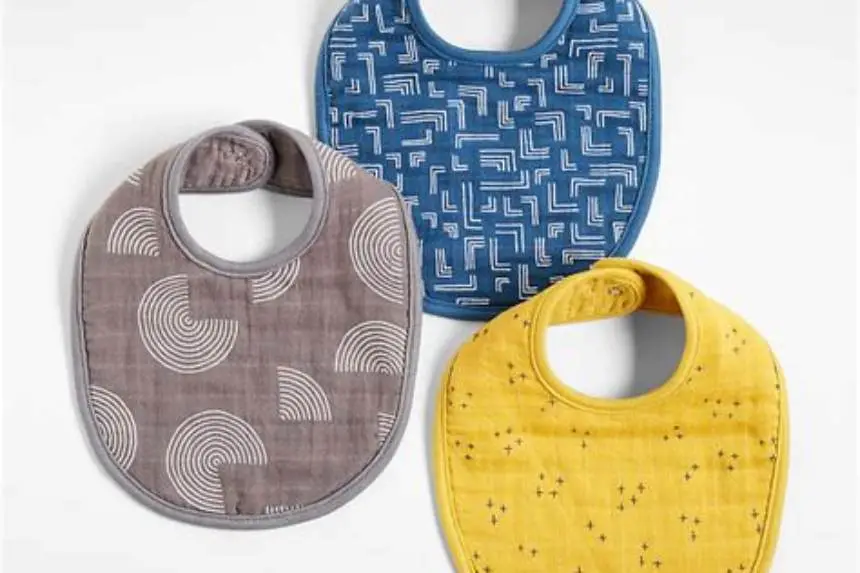
Organic cotton describes a fibre and its production chain. It does not tell you how much liquid the finished bib can hold. Weave, fabric weight, backing, seams and finishing affect performance.
Match the construction to your baby's wetness. A double-layer cotton bib may suit light drool. Heavier wetness usually needs a thicker absorbent core, terry backing or another fabric designed to hold liquid. A waterproof layer can stop liquid passing through, but it cannot replace an absorbent layer.
Check the product page for terms such as terry, loopback, brushed cotton, fleece, laminated cotton or PUL. A useful listing also gives fabric weight in g/m², often written as gsm, and the fibre content for every layer. Ask for clarification when it only says organic cotton.

Lovely Care 12 Pack Muslin Burp Cloths 100% Cotton Muslin Cloths Large
Provides a reusable 20.0 in x 10.0 in 100% cotton muslin burp cloth (pack of 12) that is described as extra soft, absorbent and machine washable, giving a full-size backup layer without adding harness-bulking pieces.
GOTS certification verifies production claims
GOTS means Global Organic Textile Standard. Its published requirements cover organic fibres, processing, manufacturing, labelling and related environmental and social criteria. Use global-standard.org for the current standard and labelling guidance. GOTS does not guarantee a bib's absorbency, drying time, fit or snap strength. Before you commit to anything, it is worth looking at cotton footed pajamas in a 61f room.
Look for a GOTS label, certification body and licence number on the product page, packaging or sewn label. Search the licence number in the GOTS database, then check the listed company, product scope and certificate status. Phrases such as “made with organic cotton” or “contains organic cotton” are fibre claims, not proof of GOTS certification. “100% organic cotton” describes fibre content unless a recognised certification claim and licence details appear too.
- Find the licence number on the listing, package or label.
- Search the number in the GOTS database.
- Match the company and product scope with the item you plan to buy.
| Detail | What it can tell you | What it leaves open |
|---|---|---|
| GOTS licence | The listed claim is covered by applicable certification requirements | Absorbency, fit and snap durability |
| Organic cotton wording without certification | The seller's stated fibre claim | Independent verification and finished performance |
| Fabric description | The listed materials and construction | How much liquid the bib holds in practice |
| Neck measurement | Whether the closure may fit your child | Comfort and coverage during movement |
Compare backing and absorbency for your baby's wetness
Start with the use case. A bib that stays mostly dry during a short walk needs less capacity than one that becomes wet across the front. Ask for the fabric weight in g/m², the exact fibre composition of each layer and any measured absorption result.
A manufacturer might publish an absorption volume in ml, a test area, soak time and test method. It might also state drying time under set wash and room conditions. A number without its method is hard to compare. No published result does not prove poor performance, but it leaves you with less evidence. For the detail, see our notes on organic cotton fabric for baby blanket.
Terry cotton has loops that can hold liquid. Brushed fabrics can feel soft and retain moisture, though warmth and drying time vary. PUL can reduce through-wetting, but it needs an absorbent side against the baby. Plain woven cotton may feel cool and dry quickly, yet often holds less liquid than thicker pile fabric.
- Use the same measured water volume for each bib.
- Dampen the same area on every model.
- Press each against a fresh paper towel for the same short period.
- Compare transfer and record drying time under similar conditions.
| Backing | Typical behaviour | Questions to ask |
|---|---|---|
| Terry cotton | Looped surface can hold more moisture | What is its weight in g/m², and how long does it take to dry? |
| Brushed cotton or fleece | Soft hand and moisture retention can vary | Does it stay damp against skin or dry quickly? |
| PUL | Limits liquid passing through | Is there an absorbent layer between the baby and PUL? |
| Plain woven cotton | Light and often quick to dry | Will it cover your baby's usual wet area? |
Rank construction features by your main priority
Choose the feature that solves your main problem. For absorbency, prioritise a thick terry or other absorbent inner layer, then a close fit and enough coverage. For breathability, prioritise uncoated cotton layers and a lighter fabric, accepting more through-wetting.
For low bulk, choose fewer thin layers and a flat closure. For leak control, place an absorbent layer against the baby and a waterproof backing behind it. A waterproof backing ranks below absorbency when the bib itself becomes soaked. We cover long term wool baby clothes care in its own article.
Example A lists 320 g/m² terry cotton, a cotton face, PUL backing and three snap positions. Example B only says “organic cotton” and shows a product photo. Prefer A when wetness and leak control matter because its construction is easier to assess.
| Main priority | Check these features first | Trade-off |
|---|---|---|
| Absorbency | Terry or pile layer, higher stated g/m², measured ml result | Can dry more slowly and feel thicker |
| Breathability | Uncoated cotton layers and lighter construction | May allow more through-wetting |
| Low bulk | Thin layers, flat seams and a small closure | Usually offers less capacity |
| Leak control | Absorbent inner layer with PUL or laminated backing | Can feel warmer and need careful washing |
Choose a pack size from your laundry routine
Pack size depends on your own use. Count damp bibs on an ordinary day, then repeat the count on a busy day. Plan for the largest number used between washes, add a small spare margin and allow for bibs still drying.
This method works better than a fixed pack recommendation. A baby who uses several bibs before bedtime needs a different rotation from one who wears one bib occasionally. Record the count for several days before buying another set.
- Count every bib that becomes damp on a typical day.
- Repeat the count on a busier day.
- Add the counts needed before your planned wash.
- Add a small spare margin for delays, outings and slow drying.
| Laundry routine | How to plan | What to measure |
|---|---|---|
| Wash nightly | Cover your busiest day's damp bibs and drying needs | Damp bibs used on that day |
| Wash twice weekly | Cover all damp bibs used before the next wash | Total damp bibs between wash days |
| Wash with other clothes | Include the next suitable laundry load | Time bibs remain damp or in the hamper |
| Air dry indoors | Allow extra pieces if drying is slow | Drying time in your usual room |
Match the bib shape to the mess
A bandana shape covers the chin and upper chest. It can suit drool that travels downward from the mouth. A wider bib reaches farther over the shirt when wetness spreads.
A pocketed bib has a different job. Its lower section can catch some food and drips during meals. It may cover more of the chest during spit-up, though no bib replaces prompt cleaning or a clothing change.
Choose the shape from the clothing area that gets wet. Bandana shapes suit chin coverage and lower bulk. Wider or pocketed shapes suit meals, broader wet patches and messes beyond the chin.
| Shape | Useful coverage | Possible limitation |
|---|---|---|
| Bandana | Chin and upper chest | Less lower-chest coverage and usually no food pocket |
| Wider bib | More shirt-front coverage | Can feel warmer or bulkier |
| Pocketed bib | Food and drips during meals | May be unnecessary for chin drool alone |
| Water-resistant bib with absorbent lining | Can reduce through-wetting | Does not absorb well if the lining is too thin |
Check fit, skin contact and closure details
Measure your baby's neck with a soft tape, leaving the tape comfortable rather than tight. Compare that measurement with the maker's stated fastening range. If no range is listed, ask the seller before buying. Age labels are rough guides.
The bib should sit flat without pressing into the jaw or leaving a wide gap. Check the fit while your baby moves. Babies with neck folds may need wider coverage, smooth edges and frequent changes when fabric becomes damp.
Check the closure type and placement. Plastic snaps offer adjustment, but detached snaps can become small loose parts. Hook-and-loop closures can catch skin or leave abrasive edges when worn. Avoid ties, loose decorative beads, bows or appliqués that can detach or wrap around the neck. Never place a bulky bib over a car-seat harness. Keep the harness flat against the body.
- Measure the neck comfortably in centimetres or inches.
- Compare the result with the product's fastening range.
- Check the bib while the baby moves.
- Remove it if dampness, rubbing or pressure appears.
| Item to check | Useful information | Reason |
|---|---|---|
| Neck fit | Measured fastening range in cm or inches | Reduces rubbing and gaps |
| Construction | Material, backing and fabric description | Shows where absorbency may come from |
| Closure | Snap, hook-and-loop or tie; adjustment positions | Helps you judge fit and care needs |
| Coverage | Approximate bib length and width | Shows how much clothing it protects |
| Care label | Wash, drying and detergent instructions | Helps preserve fabric and hardware |
| Testing information | Absorption or drying result with method stated | Separates measured claims from sales language |
Ask sellers precise questions before buying
Copy this message into a seller chat: “What is the fabric weight in g/m² for each layer? What is the exact fibre composition of each layer? Does the bib contain PUL, laminated cotton or another waterproof membrane? Do you have an absorption result in ml, or a named test method and conditions? Is the organic claim GOTS-certified, and what is the licence number?”
Compare the reply with the product page. Example A answers each question and names its terry backing. Example B repeats “100% organic cotton” but gives no weight, layer details or test method. Prefer A when you need predictable wetness protection.
- Copy the questions into a message.
- Save the reply with the product listing.
- Check whether every layer and claim has a clear answer.
- Choose another listing when key specifications remain vague.
Wash and inspect bibs during normal use
Follow the maker's care label. High heat can accelerate shrinkage and loosen the setting around snaps. Repeated pulling, poor installation and fastening the bib too tightly can also cause failure.
Wash damp bibs before they sit for long periods. Avoid fabric softener if the maker warns against it, since residue can change how fabric wets and dries. Use the stated detergent and temperature.
Lifespan varies widely. Some parents report months of use, while others replace bibs sooner depending on wear, care and frequency of use. Retire a bib when a snap detaches, stitching opens, fabric felts or thins, a sharp edge appears, persistent odour remains after washing, or absorbency has clearly declined.
| Care choice | Possible benefit | Trade-off |
|---|---|---|
| Follow the care label | Protects fabric and hardware | May require slower or cooler washing |
| Air dry | Reduces repeated high-heat exposure | Takes longer, especially indoors |
| Avoid unsuitable softener | May preserve intended wetting behaviour | Stains may need extra treatment |
| Inspect during use | Finds loose hardware or damaged seams | Requires replacing damaged bibs |
Buy a bandana pack when chin coverage matches your baby's wetness. Add a wider pocketed bib for meals or broader spit-up coverage.
Questions people still ask
How many bibs should I buy?
Count damp bibs on a typical and busy day. Cover the number used between washes, then add a small spare margin for delays and drying time.
Can I use a bandana bib for frequent spit-up?
It may not cover enough of the chest and shoulders. A wider or pocketed bib usually offers more coverage, but change wet clothing promptly.
What measurements should I check before buying?
Compare your baby's comfortable neck measurement with the maker's fastening range. Also check bib width, length, closure positions, fabric weight and care instructions.
How can I compare absorbency at home?
Dampen equal areas with the same measured water volume. Press each briefly against a fresh paper towel with similar pressure. More transfer suggests lower retention in that comparison.
What should I ask a seller?
Ask for g/m², exact fibre content for each layer, any PUL or laminated cotton membrane, and an absorption result in ml or a named test method.