Speaker or fan-forced unit: what the crib hears after ten hours
A fan-forced white noise machine sustains the output needed to reach 50 dBA at the crib from across the room for ten uninterrupted hours. Speaker units hit volume limiters, drift downward after an hour, or shut off when a timer expires or a paired phone loses connection.
On this page (9 sections)
- What matters most
- The sound level at the crib is not the level at the machine
- What a fan-forced machine has to produce to reach the target
- Where speaker-based units fall short overnight
- Fan motor hum versus broadband noise
- Ten-hour continuous running: power, placement, and toddler access
- What 'fan-forced' means on a spec sheet versus a fan-cooled speaker
- Fan-forced white noise machine instead of a speaker unit
- Questions people still ask
Part of our guide on co sleeper bassinet that attaches to full size bed

Its real fan delivers non-looping white noise all night on wall power with a tone dial and no timer to cut
Check it on AmazonThe numbers
- Target at crib
- 50 dBA, some use 45-55 dBA
- Distance penalty
- 6 dB per doubling of distance
- Grille output needed
- 50-55 dBA at 3 feet
- Speaker limiter threshold
- Usually 50-60 dBA sustained
- Fan motor frequency
- 60-120 Hz low hum
- Continuous runtime
- 10+ hours, no timer shutoff
What matters most
- Fan-forced machines produce 50-55 dBA at the grille to deliver the recommended 50 dBA at the crib across a typical nursery
- Speaker units often compress or limit output after 30-60 minutes, dropping the crib level by 5-10 dBA
- A ten-hour runtime requires either a fan motor or a speaker with no auto-shutoff timer and no phone dependency
- Fan motors add a low-frequency hum around 60-120 Hz that some babies respond to better than pure broadband noise
- Route the power cord behind furniture so a toddler cannot reach the unit or pull it down
The sound level at the crib is not the level at the machine
Most advice tells you to aim for 50 dBA at the crib, measured where the baby's head rests. That's about the volume of light rain or a quiet office. Some pediatric sleep consultants suggest a range of 45 to 55 dBA, and a few go as high as 60 dBA for particularly noisy households. The figure that matters is the one at the crib, not the one printed on the box.
Sound drops 6 decibels every time you double the distance from the source. If the white noise machine sits on a dresser three feet from the crib, and the manufacturer measured its output at one foot, you lose about 10 dB by the time it reaches the baby. A unit producing 55 dBA at one foot delivers around 45 dBA at three feet. That's the arithmetic nurseries run on.
Most white noise machines are measured at one foot in open air, which is closer than they will ever sit to a crib. Safe sleep guidelines say to keep all non-crib items at least three feet away. So you're starting with a 10 dB penalty before you factor in the room's absorption or the unit's ability to hold that output for ten hours straight.
Yogasleep Dohm Uno (White)
Its real fan delivers non-looping white noise all night on wall power with a tone dial and no timer to cut out, and single-speed operation keeps output steady from bedtime to morning.
- Is adult product False
- Size Pack of 1
- Height 4.0 inches
What a fan-forced machine has to produce to reach the target
To deliver 50 dBA at the crib from three feet away, the machine needs to produce about 52 to 55 dBA at its own grille, measured at one foot. That accounts for distance loss and absorption by soft furnishings. Hardwood floors and bare walls reflect sound better, so you can use a slightly quieter unit. Carpet, curtains, and upholstered furniture swallow more. There is more on bottle sterilizer fitting 6 bottles in a separate guide.
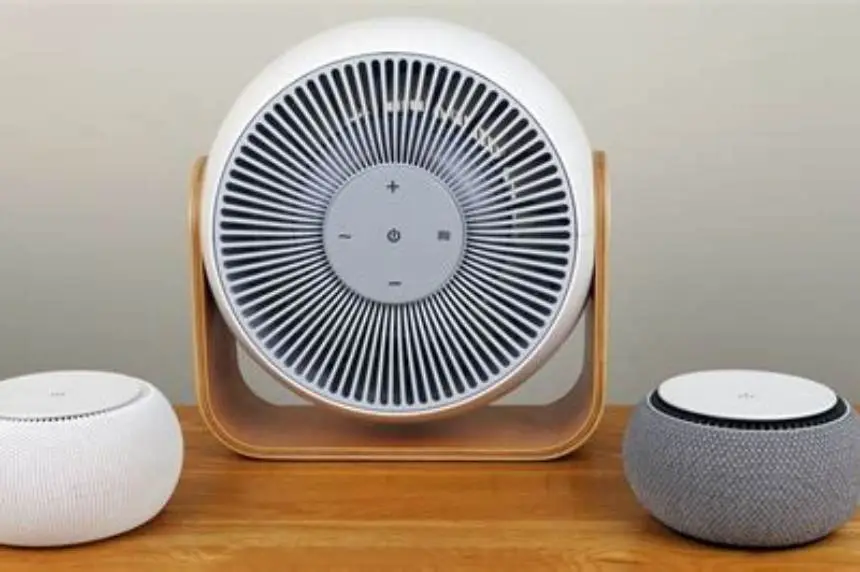
Fan-forced machines produce sound by moving air through a grille or across baffles. The motor hums at a steady pitch, usually 60 to 120 Hz, and the airflow adds broadband noise above that. The result is a sound profile with a low-frequency foundation and white noise layered on top. Babies often respond better to this than synthesized noise because the bass frequencies mask low-pitched household sounds like a furnace or voices in the next room.
Fan units with a three-speed dial typically produce 48 to 52 dBA on low, 52 to 58 dBA on medium, and 58 to 65 dBA on high, all measured at one foot. Low or medium speed delivers the right level at the crib in a standard nursery. High speed is for larger rooms or households with barking dogs and slamming doors. The output stays constant as long as the fan runs. No firmware limits it, no app dials it down, and no lithium cell loses voltage as it drains.
| Machine output at 1 ft (dBA) | Level at 2 ft (dBA) | Level at 3 ft (dBA) | Level at 4 ft (dBA) |
|---|---|---|---|
| 50 | 47 | 44 | 41 |
| 55 | 52 | 49 | 46 |
| 60 | 57 | 54 | 51 |
| 65 | 62 | 59 | 56 |
Where speaker-based units fall short overnight
Speaker units play recorded or synthesized white noise through a small driver. You get dozens of sounds, a timer, remote volume, and a sleek case. The problem shows up after the first hour. We cover sound meter for child's room in its own article.
Most units compress output to protect the driver from overheating or to meet a regulatory ceiling. The unit might start at 55 dBA but settle to 48 to 50 dBA after 30 to 60 minutes. That drop is enough to wake a baby who learned to sleep with a specific sound floor. Parents report it as 'the volume seems to go down on its own.' It does.
Bluetooth introduces another failure point. If the paired phone goes out of range or locks, the white noise stops. Some units resume automatically. Most do not. Timers are marketed as features, but they're liabilities for overnight use. Fan-forced machines stay on until you unplug them.
- Limiter threshold: Most speaker units compress output above 50-60 dBA sustained, even if they can briefly peak higher
- Volume drift: Output drops by 5-10 dBA after 30-60 minutes as thermal protection or firmware limiting engages
- Bluetooth dependency: Connection drops end playback unless the unit has a standalone mode, which many do not
- Auto-shutoff timers: Marketed as a feature but incompatible with all-night operation; most default to 1-4 hours
Fan motor hum versus broadband noise
A fan-forced machine is not producing pure white noise. The motor adds a tonal component between 60 and 120 Hz, depending on the motor speed and the number of blades. That's the low hum you hear beneath the rush of air. Some parents find it mechanical or annoying. Some babies sleep better with it than without it. For the detail, see our notes on checking safe noise levels.
White noise is technically equal energy per frequency band across the spectrum. Pink noise rolls off the highs. Brown noise rolls off further. A fan gives you something closer to pink noise with a bass bump: broadband sound above 200 Hz, and a distinct low-frequency presence below that. The bass travels through walls and floors better than high frequencies, which is why a fan in one room sometimes bothers a neighbor when a speaker unit does not.
The tonal component can mask low-pitched sounds better than broadband noise alone. A partner's voice, a door closing, a dog barking: those all have energy in the 80 to 300 Hz range, and a fan's motor hum sits right in that band. A speaker playing synthesized white noise has less energy there unless it is specifically pink or brown noise, which most nursery sound apps are not.
If the hum bothers you, a fan-forced unit with tone control or a two-speed motor lets you dial it down. Lower speed usually means a lower-pitched hum and less airflow noise. Higher speed raises the pitch slightly and adds more broadband sound. You adjust it once and leave it.
Ten-hour continuous running: power, placement, and toddler access
Fan-forced machines draw between 2 and 8 watts depending on speed. Over ten hours, that's 20 to 80 watt-hours. The motor is designed for continuous duty. Most units are rated for 24/7 operation. Clean dust from the grille every few months.
The cord must be routed so a toddler can't reach it. Run it behind the dresser and secure it with adhesive clips or cable ties. If the outlet is near the floor and the crib is nearby, you may need a cord cover or a right-angle plug.
The machine should sit on a stable surface at least three feet from the crib, per safe sleep guidelines. Dresser tops work. Shelves work if screwed into wall studs. Once a child can climb out of the crib, they can reach a dresser-top machine by pulling a drawer open and using it as a step. Move the unit to a high shelf or switch to a wall-mounted sound source.
- Measure the distance from the dresser or shelf to the crib rail. Three feet is the safe minimum.
- Place the machine on the dresser, turn it to medium speed, and measure the sound level at the crib with a phone app.
- Adjust the speed dial until the meter reads 48 to 52 dBA at the crib. Mark that setting.
- Route the power cord behind the dresser and secure it with adhesive clips so no slack hangs where a toddler can reach.
- Check the sound level again after a week. Dust and room changes can shift it by a decibel or two.
What 'fan-forced' means on a spec sheet versus a fan-cooled speaker
A fan-forced machine produces sound by moving air with a motor and blades. The fan is the sound source. A fan-cooled speaker has a small fan inside to cool the amplifier, but the sound comes from a driver playing a recording. The two are not the same, and the labels are sometimes used loosely in product listings.
Look for the words 'mechanical sound' or 'non-looping' in the bullet points. Those indicate a fan-forced design. If the listing mentions Bluetooth, app control, or dozens of sounds, it is a speaker. If it says 'real fan sound' or 'analog white noise', it is fan-forced. If it says 'white noise machine with fan', you have to read further to tell which kind it is.
A fan-forced unit usually has a dial or slider on the case to control speed. A speaker unit usually has buttons and a screen or LED indicators. A fan-forced machine weighs more because the motor and housing are heavier than a small speaker and circuit board. Pick up the box in the store, and you can feel the difference.
Some hybrid units have both a fan and a speaker, giving you the option to play recorded sounds or run the fan. These are less common and usually cost more. They solve the problem of parents who want a fan for overnight use and recorded sounds for naps or travel, but they introduce the failure modes of both systems: firmware bugs, Bluetooth drops, and mechanical wear.
Fan-forced white noise machine instead of a speaker unit
A very small nursery under 80 square feet can make even a low fan setting too loud for a parent sleeping in the same room. The sound has nowhere to dissipate. The fan's bass hum reflects off close walls. A quieter speaker unit on low volume works better, even if it means accepting a timer or Bluetooth dependency.
Thin shared walls in apartments let the fan's low-frequency hum pass through drywall into the next unit. Neighbors hear it as a constant drone. Soundproofing it is expensive. A speaker unit playing higher-frequency white noise bothers them less because highs are blocked more effectively by a single layer of drywall. Ask the neighbor before you commit to a fan machine.
If the nursery already has a ceiling fan or pedestal fan running for ventilation, adding a white noise fan may be redundant. The two motors' hums may beat against each other, producing a rhythmic pulse. A speaker unit gives you white noise without adding another motor. Turn off the existing fan for a night and see whether the baby still needs the white noise.
- Sustained output for ten hours with no drift or limiting
- No phone pairing, no app, no Bluetooth dropout
- Low-frequency hum masks household bass sounds effectively
- No timer shutoff to interrupt sleep at 2 AM
- Motor hum may bother parents in very small rooms
- Low frequencies pass through shared walls more easily
- No remote control or sound variety
- Heavier and bulkier than speaker-based units
Questions people still ask
Can I use a box fan or a pedestal fan instead of a white noise machine?
Yes, if it sits at least three feet from the crib and the cord is secured out of reach. A box fan on low produces 50-60 dBA at three feet, which is in the target range. The downside is size: it takes up floor space and cannot sit on a dresser. A white noise fan is more compact and has a smaller grille that is easier to clean. If you already own a box fan and the baby sleeps well with it, there is no reason to replace it.
How loud is too loud for a newborn's hearing?
Sustained exposure above 85 dBA at the ear can damage hearing over hours. The 50 dBA target is well below that threshold. Even a machine running at 65 dBA on the dresser delivers only 55 dBA at the crib three feet away, which is safe for continuous overnight use. The concern with white noise is not volume: it's placement. A machine placed inside the crib or within a foot of the baby's head can exceed safe levels.
Do I need to run the white noise machine for every nap, or just at night?
That depends on the nap environment. If the house is quiet during nap time, the baby may not need it. If there are siblings, pets, or daytime traffic noise, the white noise helps. Some babies learn to associate the sound with sleep and have trouble napping without it. Others ignore it entirely. Start with using it only when the house is noisy, and add it to quiet naps if the baby startles awake easily.
Will the baby become dependent on white noise and unable to sleep without it?
Some babies do learn to expect it, especially if it has been part of their sleep routine since birth. That is not necessarily a problem: it just means you bring the machine when you travel or stay at a grandparent's house. Most children outgrow the need for white noise by age three or four, and you can wean them off gradually by lowering the volume over a few weeks. A few continue to prefer it into elementary school, which is fine: it is no different from preferring a dark room or a particular blanket.
Can I use a white noise app on a phone or tablet instead of a dedicated machine?
Yes, but only if the phone stays in the room all night, stays plugged in, and is set to Do Not Disturb so notifications do not interrupt playback. A phone or tablet is not a substitute for a fan-forced machine if you need sustained, consistent output for ten hours. Apps also loop their recordings, and some babies wake when the loop restarts. A fan produces continuous, non-looping sound. If a phone app works for your baby and you are comfortable leaving the device in the nursery overnight, it is a low-cost way to test whether white noise helps before you buy a machine.