Hook-and-loop died after a year of washes: snaps or velcro?
Snaps are the better long-term pick if you wash weekly in hot water and want the stash to last a second child. Hook-and-loop grips better for fast changes but typically loses its hold after roughly 150 to 300 wash cycles.
On this page (8 sections)
- What matters most
- How many washes hook-and-loop actually survives
- What a worn snap does instead
- Cloth diapers with velcro vs snaps: the two questions that decide it
- Which works on a standing toddler and which suits a lying newborn
- Resale value and one-size adjustability
- When the cover carries the fastener instead
- Questions people still ask
Part of our guide on matching refill bags to your model
The numbers
- Hook-and-loop lifespan
- roughly 150-300 washes
- Snap lifespan
- often the life of the diaper
- Wash temperature culprit
- repeated 60C washes and drying
- Fastest change
- hook-and-loop, one-handed
- Best resale
- snaps
- Easiest for grandparents
- hook-and-loop
What matters most
- Hook-and-loop loses grip after about 150-300 washes; hot washes and tumble drying shorten that fast.
- Snaps rarely wear out - the fabric around a loose snap is usually the failure point, and that is repairable.
- If grandparents or daycare do changes, hook-and-loop (or buying snaps for you and a cover with hook-and-loop for them) avoids frustration.
- One-size diapers rely on the closure for fit across weight ranges, so closure durability equals stash lifespan.
- Snaps hold resale value better because buyers inspect closures first.
- With a separate cover system, the shell's fastener matters more than the insert's.
How many washes hook-and-loop actually survives
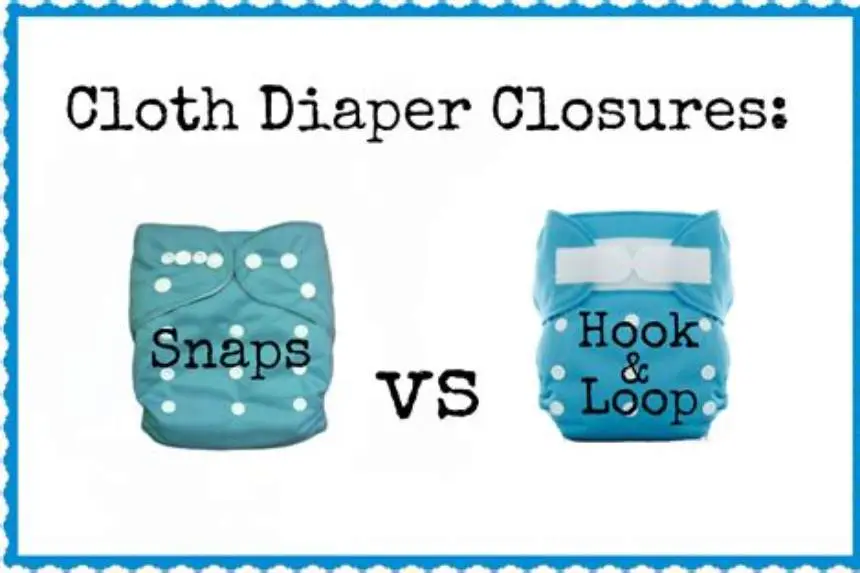
The tabs on a hook-and-loop closure are tiny hooks that grab a fabric loop. Every wash bends and blunts a few of those hooks, and every cycle with lint, diaper cream, or hair from a shedding household clogs the hooks further. Manufacturers do not publish a cycle count, but the practical range reported by families running daily washes lands around 150 to 300 cycles before the tabs stop holding through a full two or three hours of wear.
Two habits shorten that number dramatically. Washing at 60C on every cycle degrades the resin that holds the hooks to the tape, and tumble drying on hot does the same from the other side. Families who wash warm at 40C and line dry routinely get two years from a daily-wear stash; families who sanitize hot every time see the tabs give up inside a year, which matches the failure that sent you searching.
A tab is not dead the moment it feels weak. Cream residue is the most common false failure. Scrub the hooks with an old toothbrush, pick out lint with a pin, and close the tabs onto themselves before every wash so they cannot collect fluff. If that restores the grip, you have months more, not years.
When cleaning stops helping, the closure itself has worn and there is no user fix on a built-in diaper. The honest choice at that point is whether the diaper is worth restitching with new hook-and-loop tape or whether you move those diapers to backup duty. People in this spot often ask about diapers fitting newborn size as well.
- Fastest closure at every change
- Infinite size adjustment, not stepped
- One-handed, works on a wriggler
- Grip decays with every hot wash
- Cream and lint clog the hooks
- Usually first part of the diaper to fail
What a worn snap does instead
Snaps fail differently and more slowly. The plastic resin caps on a quality diaper snap are essentially inert in the wash, so after two hundred cycles a snap usually looks and presses the same as on day one. When a snap does start to fail, it loosens: the cap and socket no longer bite hard, so the closure pops open under tension when a toddler squats or climbs.
The more common failure is not the snap at all but the fabric around it. Repeated stress on a small area of cotton or polyester fleece eventually tears out, leaving a snap that hangs by a thread of fabric. This is the one real snap failure that ends a diaper's working life, and even that is repairable at home.
A three-way press or pliers snap kit reinstalls a popped or torn-out snap in a few minutes, moving it a centimeter along the wing where the fabric is intact. Most pocket diapers and fitteds use standard size 20 T5 snaps, and a repair kit costs less than a single new diaper. If you are buying snaps at all, a snap-setting pliers kit with spare size 20 resin snaps is the tool that turns closure failure from a dead diaper into a ten-minute fix. The other half of this decision is one-size pocket vs all-in-two for overnight.
Fiddliness at 3am is a fair complaint. Aligning both sides of a snap row on a dark changing table takes longer than pressing a tab down, and tired hands fumble. The fix is not a different closure but a better routine: pre-set the diaper to the last size that fit, and snap the front closure while the baby is still on the pad rather than mid-air.
- Survives hundreds of hot washes
- Cheaply repairable with a snap kit
- Toddler cannot pull it open
- Slower and needs both hands
- Stepped sizing, less precise fit
- Fabric around a snap can tear out
Cloth diapers with velcro vs snaps: the two questions that decide it
Everything above reduces to two questions, and neither is about the diaper. First: how long does each diaper size need to last? Second: who else will be doing the changes?
On longevity, match the closure to the wearing window. A newborn size is worn for a few months by one baby, so even hook-and-loop usually outlives the size. A one-size diaper that adjusts from roughly 10 to 35 pounds and stays in service for two or more years - especially if you plan a second child - needs a closure that survives as long as the fabric does, and that is snaps. There is more on flushable cloth diaper liners safe to flush in a separate guide.
On the second question, hook-and-loop wins wherever someone other than an experienced parent is changing. A grandparent, a daycare worker, or a babysitter can apply hook-and-loop correctly without instruction, because it behaves like a disposable diaper and forgivingly re-sticks if the first try is crooked. Snaps need a moment of thinking about which setting was right, and inconsistent snap settings from multiple carers cause fit and leak complaints that get blamed on the diaper.
A reasonable hybrid for many families: buy your daily-wear stash in snaps for durability, and keep two or three hook-and-loop diapers specifically for the nights and days someone else is on duty. That splits the wear-and-tear so the easy closure is fresh exactly when it matters.
| Factor | Hook-and-loop (applique/velcro) | Snaps |
|---|---|---|
| Wash cycles before failure | About 150-300, fewer if hot | Usually outlasts the fabric |
| Speed of change | Fastest, one hand | Slower, two hands |
| Fit precision | Fully continuous adjustment | Stepped, a gap between settings |
| Worn by toddler | Can be peeled open | Resists pulling open |
| Repair at home | Sew-on tape replacement | Snap pliers, minutes |
| Best for | Daycare, grandparents, newborn stage | Long-term stash, resale |
- Hook-and-loop suits any changer instantly
- Snaps suit a multi-year, multi-child stash
- A hybrid stash covers both needs
- Buying both doubles upfront cost slightly
- Splitting closure types complicates resale later
Which works on a standing toddler and which suits a lying newborn
From roughly the first birthday, changes happen standing up, half-dressed, mid-escape. Hook-and-loop is the clear winner here: you can press a tab into place one-handed on a moving target and readjust it a second later when it lands crooked. Snaps on a standing toddler mean pinning a squirming torso between your arm and the crib rail while both hands find matching studs, and the fight gets louder every month.
There is a second reason snaps lose ground with toddlers: they learn. A determined two-year-old finds that hook-and-loop peels open with two fingers and treats every quiet moment as a chance to redecorate. Snaps resist small hands almost completely, which is why potty-training-stage parents often switch to snap diapers even though the changes are harder, purely to keep the diaper on.
For a newborn, the calculus flips. A lying newborn does not pull at anything, so the peel-open risk is zero, and the change is calm enough that snapping is no hardship. What newborns do need is precise fit around skinny thighs and a low-rise front that clears the healing cord, and continuous hook-and-loop adjustment is genuinely better at dialing in that fit than stepped snaps with an inch between settings.
So the natural progression many families land on is hook-and-loop for the newborn months, snaps for the second year, and - if you want a preview of the answer - snap covers or trainers at the potty-learning stage, when keeping the diaper on matters more than changing speed.
- Hook-and-loop one-handed on a stander
- Hook-and-loop finer fit on a newborn
- Snaps stay on a diaper-peeling toddler
- Snap changes on standers are a two-person job
- Toddlers defeat worn hook-and-loop in seconds
Resale value and one-size adjustability
A one-size diaper's whole point is that the same diaper fits from about 10 to 35 pounds, and both the snap rows on the front rise and the waist closure deliver that adjustment. That makes the closure a structural part of the one-size system, not an accessory: if the closure dies, the diaper no longer fits across its range and the one-size promise collapses. This is the strongest technical argument for snaps on any diaper you intend to keep for years.
Resale follows directly. Secondhand cloth diaper buyers, often hunting for a stash for a second baby, inspect closures first because a limp hook-and-loop tab means re-stitching a whole stash. Snapped diapers routinely sell for a meaningfully higher share of new price, and listings that mention 'snaps only' in the title draw faster inquiries. Hook-and-loop diapers still sell, but the price reflects that the buyer is gambling on tab condition.
The style market leans the same way. Many popular prints and colors are released in both closures, but limited runs and popular prints circulate in snaps because that is what collectors and stash-builders want. If you ever foresee trimming your stash, snaps protect the investment; if you are buying a friend's used stash, use the same logic and pay less for worn tabs - or budget for sewing on replacement hook-and-loop tape yourself, which is a straightforward job with sew-on tape and a needle.
- Snaps protect resale price
- Snap rows carry the one-size rise range
- Replacement tape is sewable at home
- Hook-and-loop diapers resell at a discount
- Worn tabs cost the buyer repair time
When the cover carries the fastener instead
If you use a two-piece system - absorbent inserts plus a separate waterproof cover - the closure conversation moves to the cover, and everything else changes. Covers in good condition are reused across several changes, wiping the inside clean between uses, so the closure gets far fewer stress cycles per diaper change than an all-in-one does. A quality snap cover can genuinely serve two children.
The insert under the cover usually needs no closure at all, or just a small snap to hold it rolled for stuffing and storage. So for two-piece systems, put your durability money into the cover closure and treat insert closures as convenience features. Covers with snap closures at the waist and hip are the standard for longevity; covers with hook-and-loop are the standard for daycare and grandparents, for the same reasons as above.
One practical wrinkle: some families keep one hook-and-loop cover purely for caregivers, as noted earlier, and snap covers for daily use. Others skip the dilemma by choosing covers that offer both, or by buying a cover whose hook-and-loop is replaceable. Check the manufacturer's own fit range and weight limits before buying any cover - those limits, not closure preference, decide whether the cover works for your baby's size today.
- Cover closures survive many more uses
- Snap covers last through siblings
- Inserts need no closure at all
- Two pieces cost more upfront
- Hook-and-loop covers wear like all-in-ones do
Snaps for a stash meant to last years or resell; hook-and-loop for newborn precision and anyone else who changes the baby.
Questions people still ask
Can I replace the hook-and-loop on a diaper myself?
Yes, on most pocket and cover styles. Cut off the old tape, and stitch sew-on hook-and-loop tape of the same width along the original line with a needle and polyester thread, or use a sewing machine. It takes about fifteen minutes per diaper and costs very little.
Do snaps pop open on their own?
A quality resin snap should not release under normal movement. If one does, either the snap has loosened with age or the fit is too tight across the hip and stressing it. Test it with a firm sideways tug and repair it with a snap kit if it gives.
Does washing in hot water really ruin velcro tabs that fast?
It is the biggest single factor. Hot washes and hot drying degrade the adhesive and resin holding the hooks, so a tab that would last two years at 40C can fail within one. Wash warm and line dry when you can.
Which closure should I choose for daycare?
Hook-and-loop, without hesitation. Daycare staff change many babies a day and apply hook-and-loop correctly with no instruction. Keep a couple of hook-and-loop diapers or a hook-and-loop cover just for daycare days.
Are hybrid closures with both snaps and hook-and-loop worth it?
They exist and work, but the hook-and-loop portion still wears out, and a tab flopping over snap rows can snag in the wash. If you want both benefits, keeping separate diapers for each job is usually tidier.