6 month old and an indoor swing: what limit ends first
At six months, the maker's sit-up or climb-out rule ends swing use first - almost never the weight limit. A typical six-month-old weighs 16 to 19 pounds, well under the 20 to 25 pound ceiling most swings print, but once your baby rolls or pushes to sitting unassisted, most manuals say supervised swing time is over.
On this page (8 sections)
- What matters most
- Which limit ends an indoor baby swing for a 6 month old first
- Seat depth, shoulder straps and leg room a six-month-old actually needs
- Recline positions when your baby wants to sit upright
- Full-size swing versus portable swing at six months
- Motor noise and swing speed for a distractible six-month-old
- What to measure at home before buying, and when a swing is the wrong buy
- Questions people still ask
Part of our guide on which stacking rings are safe for 6 month old
The numbers
- Typical 6-month weight
- 16 to 19 lb
- Common swing weight ceiling
- 20 to 25 lb
- Limit that ends use first
- sit-up / climb-out rule
- Seat depth that fits
- 10 inches or more
- Shoulder strap slots
- lowest slot at or above shoulders
- Portable swing power
- 4 to 5 C or D batteries
- Full-size swing footprint
- roughly 30 x 35 inches
What matters most
- The sit-up rule, not the weight limit, ends swing use at six months
- A typical six-month-old is 16-19 lb against a 20-25 lb swing ceiling
- A shallow seat and low shoulder straps mean a strong sitter slumps forward
- Measure your floor space and outlet position before ordering a plug-in swing
- A stationary bouncer or floor seat does the same job without the time limit
Which limit ends an indoor baby swing for a 6 month old first
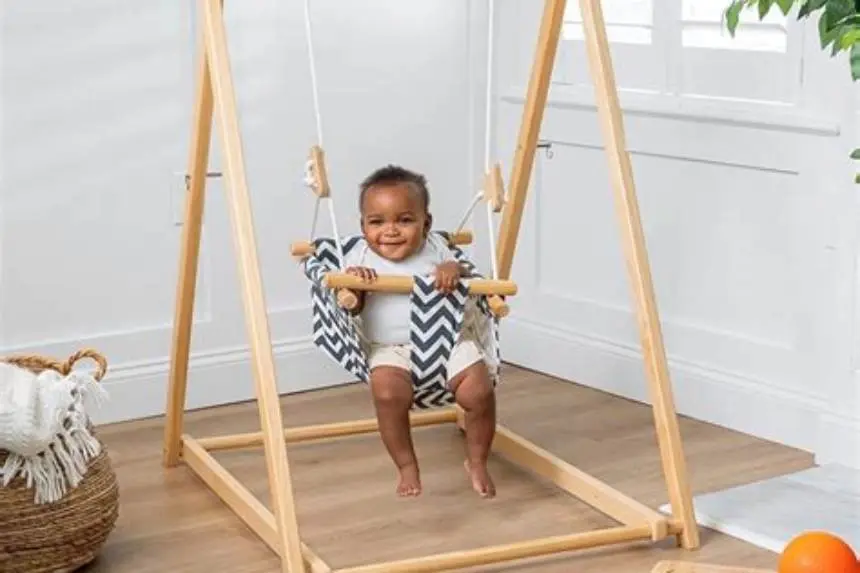
Every swing has two endings. The box gives a weight limit of 20, 25, or sometimes 30 pounds. The manual gives a behaviour limit. It may say to stop when your baby climbs out, rolls over, or sits upright without help.
Typical six-month-olds in the US weigh 16 to 19 pounds. That leaves 2 to 6 pounds below a 20 to 25 pound limit. The printed number suggests months of use remain. Rolling, sitting, and pushing up often begin around this age.
The behaviour rule usually ends use first. Trunk control lets a baby shift forward inside a moving seat. Shallow swing seats aren't built for an active escape attempt. If your baby has rolled into sitting once, many manuals treat use as finished.
Read the supervised-use wording before buying. Check the manual or listing, not only the box weight. Babies not yet sitting alone might give you weeks or a couple of months. Plan around that window, not the scale. People in this spot often ask about indoor play tunnel for 2 year old as well.
| Limit | Where it is written | Typical value | When it fires at six months |
|---|---|---|---|
| Weight limit | Box, bullet points, spec table | 20-25 lb | Usually not yet. Baby is 16-19 lb |
| Sit-up / climb-out rule | Manual, supervised-use wording | Rolling to sit or pushing upright | Common around six months |
| Practical result | - | - | Behavioural rule ends use first |
Seat depth, shoulder straps and leg room a six-month-old actually needs
Swing seats are shaped for a curled-up newborn, and a six-month-old is no longer that shape. The three measurements that decide whether the seat still fits are seat depth, shoulder-strap height and leg room. You can check all three from the listing's dimensions and photos before you spend anything.
Seat depth is the distance from the back of the seat to where the crotch strap or leg opening begins. Newborn seats run shallow, around 8 inches, which is fine for a curled baby and useless for a long-legged six-month-old whose thighs hang past the edge. Look for 10 inches or more, or a seat described as having a leg-length adjustment. A seat that is too shallow forces the baby's bottom forward and the shoulders down into a slump.
Shoulder straps should come out of the seat at or slightly above your baby's shoulders. Most swings have two or three height slots, and by six months your baby should already be in the highest one. If the photo shows the straps emerging below the midpoint of the seat back, assume a six-month-old will outgrow the harness position before anything else fails. The other half of this decision is supporting 50 pound weight swings.
Leg room is the loosest of the three, but it matters for how long the seat stays comfortable. A six-month-old's legs bend at the knee over the front edge; if the edge sits mid-thigh, the baby rides with knees jammed against the tray. Roughly 12 to 14 inches of seat front-to-back behind the leg opening covers most six-month-olds up to the weight ceiling. Any listing that gives you none of these three dimensions is telling you it was designed for smaller babies.
| Measurement | Fits a six-month-old | Too small looks like |
|---|---|---|
| Seat depth | 10 inches or more | Thighs hang past the seat edge |
| Shoulder strap height | Highest slot at or above shoulders | Straps emerge mid-back or lower |
| Front-to-back seat | 12-14 inches behind leg opening | Knees pressed against the tray |
Recline positions when your baby wants to sit upright
Newborn swings recline nearly flat, because a newborn has no trunk control and needs the support. At six months the opposite is true: your baby has spent weeks practising sitting and now hates being laid back. A fully reclined six-month-old cranes forward against the straps, arching to see the room, which is both uncomfortable for the baby and exactly the posture the climb-out warning is written about.
What you want at this age is a seat that moves to a true upright position - back roughly vertical, not the 45-degree compromise many swings top out at. Check the listing for the number of recline positions and, more importantly, for the description of the most upright one. Words like 'upright seated position' in the bullets are worth something; 'adjustable recline' alone tells you nothing, because every swing says it and the range varies hugely. Before you commit to anything, it is worth looking at which baby balance bike fits a 12 month old.
There is a tension here worth naming plainly. The safest posture for a sleeping baby in a swing is the more reclined one, and the posture a six-month-old actively wants is the most upright one. A swing with only a deep recline becomes a fight; a swing with a genuine upright position stretches its useful life at this exact age. Motorised seat-angle adjustment is a nice-to-have, not a need - a manual reposition you do once per session is enough, since you are supervising anyway.
One honest caution: even in a truly upright seat, a six-month-old who can sit unassisted has usually already triggered the manual's stop rule. A good upright recline buys you comfort for the weeks you have, not extra months. If a seller's photos show a baby older than about five months riding upright and happy, that is marketing, not an endorsement - check the manual's own wording for the age it supports.
Full-size swing versus portable swing at six months
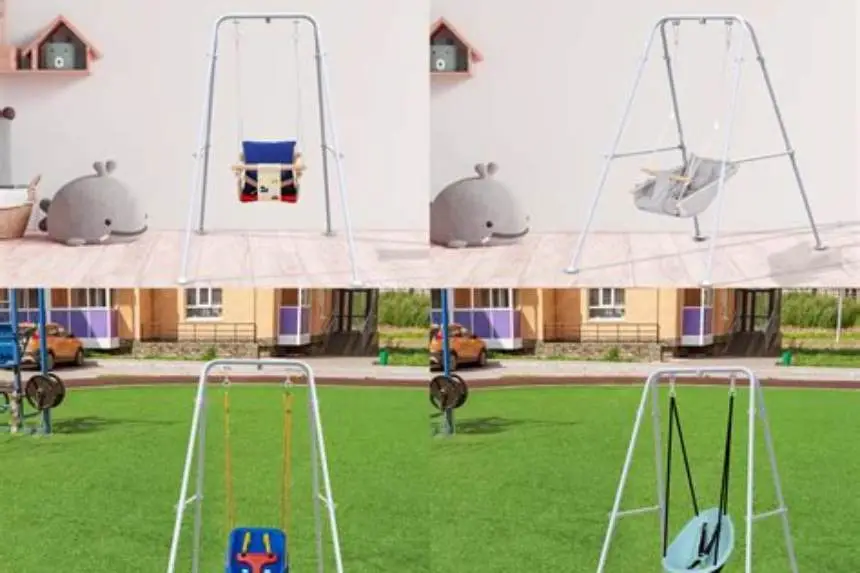
By six months the full-size versus portable decision comes down to three things: seat size, floor space and power. Full-size plug-in swings carry bigger, deeper seats with higher weight ceilings - often 25 to 30 pounds - and longer, smoother side-to-side arcs. Portable swings are built for a newborn's first months, with smaller seats, 4 to 5 C or D batteries and shorter front-to-back motions that many six-month-olds find less engaging than they did at eight weeks. The other half of this decision is child development and play.
Footprint is the number people underestimate. A full-size swing needs roughly 30 by 35 inches of floor space, more when the seat swings wide at the end of its arc, so budget a clear circle about 4 feet across. Portables run nearer 20 by 25 inches and often fold flat, which is why they survive in small homes. Measure the spot before you order; a swing that blocks a hallway for months it will barely be used is a bad trade.
Power is where the two types diverge sharply. A plug-in full-size swing draws from a wall outlet and costs nothing to run. A battery portable eats four or five C or D cells roughly every one to two weeks with daily use, which works out to a real recurring cost and a dead motor at the worst moment - usually the afternoon stretch when you need it most. If the swing will live in one room near an outlet, plug-in wins outright; if it travels between floors or to grandparents, batteries are the price of that.
At six months specifically, there is a third consideration: remaining lifespan. A portable's smaller seat and lower weight ceiling mean it gets outgrown sooner, so buying one at this age often means retiring it within weeks. A full-size unit with a 25-plus pound ceiling and a deep, well-shaped seat at least gives the weight limit room to matter.
| Measure | Full-size plug-in | Portable battery |
|---|---|---|
| Footprint | About 30 x 35 inches | About 20 x 25 inches, folds |
| Power | Wall outlet, no running cost | 4-5 C or D batteries, 1-2 weeks |
| Weight ceiling | Typically 25-30 lb | Typically 20-25 lb |
| Seat depth | Usually 10 inches or more | Often under 9 inches |
| Swing arc | Longer side-to-side | Shorter front-to-back |
- Full-size: plug-in power, larger seat, longer arc
- Portable: folds flat, small footprint
- Full-size: weight headroom into 25-30 lb
- Portable: moves between rooms easily
- Full-size: needs about 4 feet of clear floor
- Portable: eats 4-5 C or D batteries weekly
- Portable: smaller seat outgrown sooner
- Full-size: fixed to one outlet location
Motor noise and swing speed for a distractible six-month-old
Six-month-olds notice more than newborns. The swing must compete with toys, faces, and household noise. Two figures help: the number of speed settings and, when listed, the motor's noise level.
Choose at least five speeds. Gentle motion can suit a calm baby, while a fussy baby may need more movement. Two speeds often feel either dull or frantic. Arc length matters too. A side-to-side arc of 30-plus inches feels more substantial than a short front-to-back jiggle.
Noise depends on its pattern, not only its volume. A quiet motor can help a drowsy baby settle. A steady, audible hum can hold an alert baby's attention like white noise. Speed changes during each cycle may wake a light sleeper more easily than a constant hum.
Reviews often help more than quoted decibels. Look for comments about steady or intermittent noise. Six-month-olds stay awake for two to three hours at a stretch. Treat the swing as entertainment, not a sleep tool.
What to measure at home before buying, and when a swing is the wrong buy
Four home checks can settle the choice. Tape the listed footprint on the floor, then add about 8 inches on each side of the arc. Keep coffee tables, radiators, and stairs outside that space. Check the outlet too. A plug-in swing needs a socket within cord length. Never run an extension cord beneath its frame.
Measure the highest point, including any mobile. It must clear door frames if you move the swing between rooms. Face the seat toward the household, since babies this age want to watch people. Tight storage calls for a fold or quick-release frame.
A swing is often the wrong buy at six months. Rolling to sitting or pushing up on hands may already meet the manual's supervised-use rule. Don't buy one as a sleep surface. Swings aren't for unsupervised or overnight sleep. Use a safe crib or bassinet instead.
Consider a stationary bouncer, floor seat, or activity saucer. A bouncer provides semi-reclined movement without a motor, outlet, or arc. Many accept babies to 25 pounds or more. Floor seats suit upright babies who want to watch the room. They take less space and avoid the swing's early sit-up limit.
- Tape the footprint plus
8 inchesof arc clearance on the floor - Confirm an outlet within the cord's reach, with no extension lead
- Check doorway clearance for the tallest point and any mobile
- Read the manual's supervised-use wording for the sit-up rule
- Compare a bouncer or floor seat before ordering
At six months, buy on the weight ceiling but expect the manual's sit-up rule to end swing use first - a bouncer or floor seat is often the better spend.
Questions people still ask
Can my six-month-old sleep in the swing?
No maker's manual supports unsupervised or overnight sleep in a swing, and the supervised-use wording assumes an awake, watched baby. If your baby falls asleep in the seat, the usual instruction is to move them to a firm, flat sleep surface. Treat the swing as an awake-time seat only.
My baby is small for their age - does the weight limit buy more time?
It buys time on the scale, but not on the behaviour rule. A smaller six-month-old may still be under the weight ceiling for months, yet the moment they roll to sit or push upright, most manuals end supervised use regardless of weight. Check the manual's wording, not just the pounds.
How long will a swing bought at six months actually get used?
Realistically weeks, not months. If your baby is not yet sitting unassisted, you may get a couple of months before the manual's rule cuts in. Buying a full-size swing with a 25-plus pound ceiling at least means the weight limit is not the thing that stops you first.
Is a battery portable worth it at this age?
Usually not as a primary swing. Portables have smaller, shallower seats and lower ceilings, so they get outgrown soonest, and they burn through four or five C or D batteries every week or two. They earn their place for travel or grandparents' houses, not for the daily spot in your living room.
What should I buy instead if my baby has outgrown the swing?
A stationary bouncer or a floor seat. A bouncer gives hands-free bobbing to higher weight limits with no motor and no sit-up rule; a floor seat suits an upright baby who wants to watch the room. Both match what a six-month-old actually wants from a swing.