Will a Stroller or Travel Crib Fit Through a 76 cm Doorway?
A 76 cm doorway will fit any single stroller comfortably, since most run 52 to 62 cm wide. Side-by-side doubles won't clear it. Travel cribs folded to 76 cm depth or less will fit your closet, but measure the packed bag, not the crib itself.
On this page (8 sections)
Part of our guide on strollers fitting 80cm crossbars
The numbers
- Single stroller width
- 52-62 cm at wheels
- Double stroller width
- 72-80 cm side-by-side
- Clearance needed
- 4-6 cm margin for doorways
- Travel crib folded depth
- 20-28 cm in carry bag
- Tandem stroller width
- 56-64 cm, same as singles
What matters most
- Single strollers are 52-62 cm wide and clear a 76 cm doorway with room to spare
- Side-by-side double strollers run 72-80 cm wide and won't fit through 76 cm openings
- Measure stroller width at the widest point, usually the rear wheel axle
- Travel cribs fold to 20-28 cm deep in their bags, far smaller than 76 cm closet depth
- Check folded dimensions if you're storing the stroller in that same 76 cm closet
Will my stroller clear a 76 cm doorway
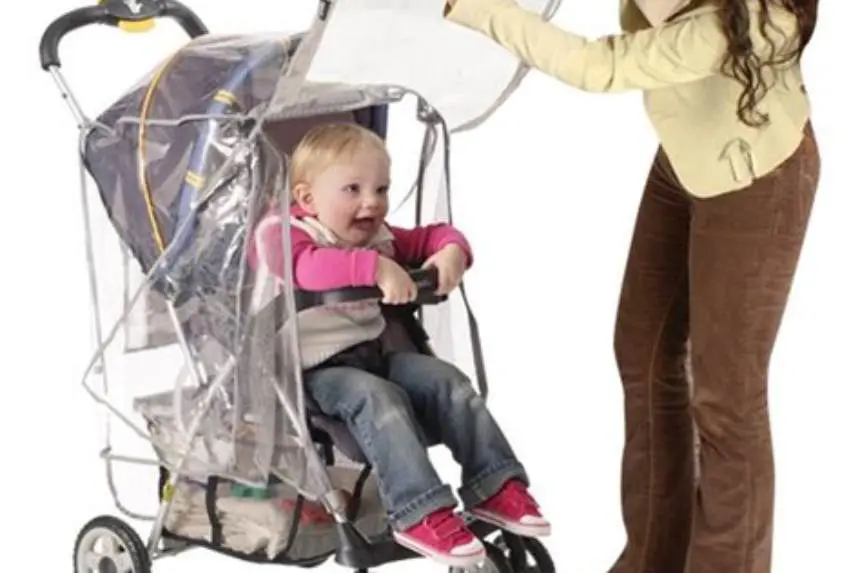
Yes, if it's a single stroller. Most singles measure 52 to 62 cm wide at the rear wheels, the widest point. That leaves you 14 to 24 cm of clearance on a 76 cm doorway, more than enough to roll through without scraping the frame or catching a wheel.
Side-by-side double strollers won't make it. They run 72 to 80 cm wide, which puts them at or over your doorway width. Even a 72 cm model leaves only 4 cm total clearance, and that assumes the doorway is exactly 76 cm and the stroller is perfectly straight as you push it through. In practice, you'll wedge it.
Tandem doubles, where one seat sits behind the other, are the same width as singles. They're longer front to back, but that doesn't matter for doorway clearance. If you need a double stroller and you have narrow doorways at home or in buildings you visit often, a tandem is the layout that fits.
Jogging strollers with three wheels are usually 58 to 64 cm wide. The single front wheel keeps the overall width similar to a standard single stroller. A few all-terrain models with fat tires push up to 66 cm, still comfortably under 76 cm. We go through using fold-flat seats for extra trunk space step by step elsewhere on the site.
| Stroller type | Typical width | Clears 76 cm doorway |
|---|---|---|
| Single stroller | 52-62 cm | Yes, 14-24 cm clearance |
| Tandem double | 56-64 cm | Yes, 12-20 cm clearance |
| Side-by-side double | 72-80 cm | No, too wide or tight |
| Jogging stroller | 58-64 cm | Yes, 12-18 cm clearance |
How to measure stroller width and folded dimensions
Measure the stroller at its widest point, which is almost always the rear wheel axle. Extend a tape measure straight across from the outside edge of one rear wheel to the outside edge of the other. Don't measure at the handlebar or the canopy, they're narrower and won't tell you whether the wheels will clear.
If you're shopping online and the manufacturer lists only one width figure, assume it's the wheel measurement. If they give handlebar width separately, ignore it. The wheels are what hit the doorframe.
For folded dimensions, you need three measurements: height, width and depth when the stroller is collapsed. Fold it the way you'll store it, then measure the longest side, the widest side, and the front-to-back depth. Those numbers tell you whether it fits in a closet, a car trunk, or under a bed. A 3-meter retractable tape measure with metric markings makes this quick. If that sounds like your situation, read up on safe exersaucer alternatives next.
Some strollers fold with the wheels sticking out to the side. Others fold with the wheels tucked under or folded flat. The folded width can be wider than the unfolded width if the wheels splay out when you collapse the frame. Measure it folded, don't assume.
- Unfolded width: measure straight across the rear wheel axle, outside edge to outside edge
- Folded width: measure the stroller collapsed, at its widest point including any protruding wheels
- Folded depth: measure front to back when collapsed, this is what matters for closet fit
- Folded height: measure floor to tallest point when collapsed, matters for overhead storage or car trunks with covers

Lufkin 3M/10' Power Tape
Gives you a 3 meter tape measure with metric markings to measure stroller width and folded dimensions accurately.
How stroller folding affects doorway clearance
Folding a stroller makes it narrower only if the wheels fold inward or the frame collapses side to side. Most strollers fold forward or upward, which shortens the length and height but leaves the width unchanged. The rear wheels stay the same distance apart whether the stroller is open or folded.
A handful of compact travel strollers fold with the wheels tucked in, reducing the width by 8 to 12 cm. These are usually lightweight models under 7 kg, designed to fit in airplane overhead bins. If doorway clearance is tight, check whether the fold brings the wheels together. The product listing or manual will show the folded dimensions.
You won't gain doorway clearance by folding a standard full-size stroller. You fold it to store it or load it in the car, not to fit through a door. If the stroller doesn't fit through the doorway unfolded, you'll have to fold it, carry it through, and unfold it on the other side. That's awkward with a baby in your other arm.
Somejogging strollers let you remove the front wheel to narrow the frame for storage. That doesn't help with doorways because you're not going to pop the wheel off every time you enter a building. It's a storage feature, not a daily-use feature.
Will a travel crib fit inside my closet depth
Yes, easily. Travel cribs fold down into a carry bag that's typically 20 to 28 cm deep, far smaller than a 76 cm closet. The crib itself when set up is 65 to 75 cm deep, but you're not storing it set up. You're storing the folded bag.
Measure the carry bag, not the assembled crib. The bag is a long, narrow cylinder or rectangle. Most are 75 to 85 cm long, 18 to 22 cm wide, and 20 to 28 cm deep. The depth is the dimension that matters for closet shelves or floor storage against the back wall.
If you're stacking the travel crib bag on a closet shelf, check the shelf depth. Standard closet shelves are 30 to 40 cm deep, so a 76 cm closet will have shelves that easily hold a 20 to 28 cm bag with room in front for other items. If you're standing the bag upright on the closet floor, the 20 to 28 cm depth leaves 48 to 56 cm of space in front of it in a 76 cm closet.
Some travel cribs come with a backpack-style carry bag instead of a duffle. The dimensions are similar, but the bag sits flatter against the closet wall because it doesn't have rounded ends. Either style fits a 76 cm closet with no trouble.
Clearance margin you actually need
Plan for 4 to 6 cm of total clearance when you're rolling a stroller through a doorway. That's 2 to 3 cm on each side. It gives you room to angle the stroller slightly if the doorway isn't perfectly aligned with your approach, and it keeps the wheel hubs from scraping the frame or trim.
You can squeeze through with less clearance if you line up carefully and push straight, but you'll scrape the doorframe often enough to mark it. The plastic wheel guards on stroller frames are there because parents hit doorways constantly. If you have less than 4 cm total clearance, expect cosmetic damage to both the stroller and the doorframe over time.
Doorways are rarely exactly square. Older frames sag, trim pieces aren't plumb, and floors slope. A doorway stamped as 76 cm might measure 74 cm at the bottom and 77 cm at the top. Measure at handle height, roughly 90 to 100 cm off the floor, because that's where the widest part of the stroller will pass through.
If you're testing fit with a stroller you already own, roll it through the doorway at normal walking speed. If you have to slow down, aim carefully, or wiggle the frame to get it through, the fit is too tight for daily use. You'll be doing this with a baby in the stroller, a bag on your shoulder, and your mind somewhere else.
When width matters more than you expect
Width matters most in rental apartments, older buildings, and public restrooms. Bathroom stall doors are often 60 to 65 cm wide, narrower than a side-by-side double stroller and tight even for a wide single. If you take your stroller into public restrooms often, keep it under 58 cm wide or you'll be leaving it outside the stall.
Elevators in older buildings have narrow doors. A 76 cm doorway is common in pre-1980 apartment buildings, and the elevator door in the same building might be only 70 cm. Check both before you buy a stroller, or you'll be folding it to get on the elevator every time you leave your floor.
Narrow store aisles are another choke point. Grocery stores and pharmacies usually have 90 cm aisles, wide enough for any single stroller. Boutique shops, older hardware stores, and crowded markets often have 70 to 80 cm aisles. A 62 cm stroller fits, a 78 cm side-by-side doesn't. That's the difference between shopping with your baby and leaving the stroller outside.
If you live in a city and walk more than you drive, stroller width shapes your day. You'll notice every doorway, every threshold, every narrow sidewalk. A single stroller opens doors a double stroller keeps closed. That's not a metaphor.
Questions people still ask
Can I make a double stroller narrower by removing one seat?
No. The frame width is fixed by the wheel base, and the seats attach to that frame. Removing a seat lightens the stroller but doesn't change the distance between the wheels. If you need a narrower double, buy a tandem model where the seats are front to back instead of side by side.
Do stroller wheels wear out faster if I scrape doorways often?
The wheels themselves hold up fine, but the plastic wheel guards and the frame tubes get scratched and eventually crack. You'll also mark up your doorframes. If you're scraping regularly, the fit is too tight and you need a narrower stroller or wider doorways.
Will a stroller fit through a doorway if it's the same width as the door?
Not reliably. A 76 cm stroller and a 76 cm doorway means zero clearance. You'll wedge it more often than not, and you'll have to angle the stroller and force it through. Plan for at least 4 cm of total clearance, 2 cm on each side.
Are umbrella strollers narrower than full-size strollers?
Usually, yes. Umbrella strollers typically measure 44 to 52 cm wide, about 10 cm narrower than a standard single stroller. That's because they have smaller wheels and a simpler frame. The narrow width is one reason parents keep an umbrella stroller even after buying a full-size model.
How do I measure a doorway correctly for stroller fit?
Measure the clear opening from one inside edge of the doorframe to the other, not the door slab and not the trim. Measure at about hip height, where the widest part of the stroller will pass through. If the doorway narrows at the bottom because of trim or a threshold, measure there too and use the narrower figure.