Tile floor, deep tub: what a bath kneeler and elbow rest must clear
A bath kneeling pad and elbow rest only works if its thickness matches your tub: with a rim under 14 inches, a pad thicker than about 1 inch pushes your elbows off the ledge, while rims above 20 inches leave your arms below the padded edge no matter the pad. Check suction against your floor type first.
On this page (9 sections)
- What matters most
- Choosing a bath kneeling pad and elbow rest starts with two numbers
- How pad thickness changes your elbow height, and where thick turns bad
- Is the elbow rest worth anything if it misses your forearm?
- Suction on glazed porcelain, textured tile and acrylic: what holds and what peels
- Foam types compared: EVA, TPE, rubber, open-cell and memory foam
- When kneeling is the wrong answer and a bath stool wins
- Fixed one-piece sets: why they are sold one size and what to check
- Questions people still ask
Part of our guide on tear-free baby shampoo with no sulfates
The numbers
- Pad thickness, low rim
- 1 inch or less
- Pad thickness, mid rim
- 1.5 to 2 inches
- Thick becomes worse at
- rims under 14 inches
- Kneeler stops working at
- rims over 20 inches
- Best suction surface
- Glazed porcelain
- Worst suction surface
- Textured or matte tile
- Typical pad price
- $15-$40
- Kneeling switch point
- Pain at 5-10 minutes
What matters most
- Measure tub rim height from the floor before buying any kneeler
- Rims 15-18 inches: keep pad thickness in the 1.5 to 2 inch range
- Rims under 14 inches need a pad of 1 inch or less
- Suction cups hold glazed porcelain but peel off textured or matte tile
- Closed-cell foam and EVA drain and dry; open-cell and memory foam stay wet underneath
- Bad knees, low rims or a deep tub mean a bath stool is the better tool
Choosing a bath kneeling pad and elbow rest starts with two numbers
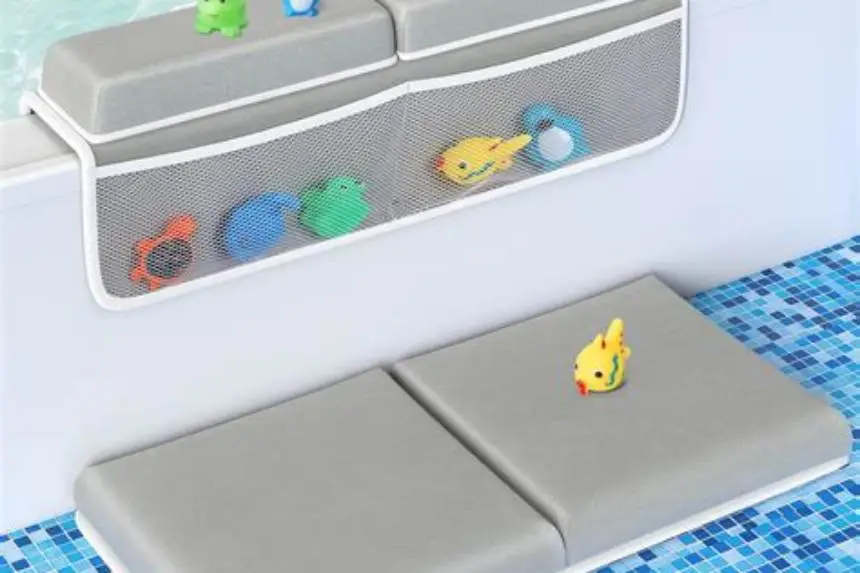
Measure your tub rim height from the floor. Then check your floor finish: smooth and glazed, or textured. Those two numbers decide which bath kneeling pad and elbow rest will work and which will fold in a closet by February.
Rim height matters because the pad raises your knees and your whole body. Floor finish matters because most sets use suction cups, and suction is picky about surfaces. Take the measurement with a tape measure from the finished floor to the top edge of the rim where you would kneel, usually the long side. Write it down.
Deck-mounted or rimless tubs need a different approach. Measure to the highest point you would lean on: the deck edge, a tiled surround lip, or the top of a baby tub sitting inside. That surface is your effective rim. Every thickness rule below applies to it.
Press a fingertip to the floor. Smooth and shiny means suction will hold. Grit, texture or matte finish means suction will let go within a week. We cover how often to replace baby sponge in its own article.
How pad thickness changes your elbow height, and where thick turns bad
The geometry is simple and nobody on the ranking pages spells it out. A pad under your knees raises your knees by its thickness. Your elbows rise by almost exactly the same amount, because your body is a fairly rigid line from knees to shoulders when kneeling. If your elbows were resting comfortably on the rim at floor level, a pad of the wrong thickness moves them off that ledge.
With a low rim, under about 14 inches from the floor, a thick pad is actively worse than a thin one. A 3-inch pad under a 14-inch rim pushes your elbows an inch or two above the ledge. Your arms end up hovering with nothing under them, and you hunch forward over the tub to reach the water. Every minute of that is strain in your shoulders and lower back, which is the exact problem the pad was bought to solve.
With a mid-height rim, about 15 to 18 inches, a pad in the 1.5 to 2 inch range lands most adults' forearms square on the elbow rest. Many of the one-piece sets on the market are built for these mid-height rims, which is why this band matches the most common listings. It helps to understand baby bath neck support before going further.
With a deep tub, a rim above about 20 inches, the problem flips. Even a thick pad leaves your arms below the ledge, unsupported for the whole bath. No kneeler fixes that; the answer is a raised bath stool or a bench, covered in the section below. If your elbows miss the rim even with the pads you own, the pads are not the wrong model. Kneeling is the wrong position for your tub.
| Rim height from floor | Pad thickness that works | What happens when it is wrong |
|---|---|---|
| Under 14 inches | 1 inch or less | Elbows ride above the ledge; shoulders hunch |
| 15 to 18 inches | 1.5 to 2 inches | Standard sets fit; forearms land on the rest |
| Over 20 inches | No kneeler fits | Use a stool or seat instead |
Is the elbow rest worth anything if it misses your forearm?
Only sometimes, and it is worth checking honestly. The elbow rest earns its place when your forearms actually land on it at your working height. That contact is what takes the load off your shoulders during the long parts of a baby bath: rinsing hair, scrubbing with two hands, holding a wriggler steady. Contact is the whole point.
If the rest sits below your forearms, it does nothing. Your arms hover just above it, engaging your shoulder and neck muscles exactly as they would with no pad at all, and you have bought decoration. If it sits above them and you have to drop your chest to reach it, it is worse than nothing, because it pulls your spine out of line. Before you commit to anything, it is worth looking at fit nuby tub in small sink.
There is a cheap test before you buy anything. Kneel on the floor beside your empty tub in your normal washing position and notice where your forearms naturally fall relative to the rim. If they rest on the rim already, a thin pad is all you need and the elbow rest is a bonus. If they sit well below the rim, no amount of pad thickness will bring the ledge down to you.
Check the width too. A rest narrower than about 12 inches forces both forearms onto a strip, and one arm ends up half off the edge. Wider is better when you are working with two hands in the water.
- Forearms must touch the rest at your natural kneeling height, or it does nothing
- Test your natural forearm position on the empty tub before buying
- Aim for a rest at least 12 inches wide for two-handed work
- A rest above your elbows pulls your spine forward; skip it
Suction on glazed porcelain, textured tile and acrylic: what holds and what peels
Suction cups are a materials story, and the checkable fact nobody states is this: suction holds best on hard, smooth, non-porous surfaces and fails on anything with texture, tooth or flex. Glazed porcelain tile and glazed ceramic are the ideal surface. The cup flattens against a glassy finish and can hold for months. Press the cup on, push the center to expel the air, and it stays.
Textured, matte or stone-look tile is the failure case. Those finishes have micro-roughness that lets air seep back under the cup edge, so the pad detaches partway through a bath, usually at the worst moment, with a wet baby in the tub. Matte tile looks smooth to the eye and still defeats suction; run a fingertip across it and feel the drag that a glazed tile does not have.
Acrylic tub skirts and fiberglass are the middle case. They are smooth, but they flex slightly under load, and that flex slowly releases the vacuum. Cups that grip porcelain can slide down a flexing acrylic panel under load. On any of these unreliable surfaces, ignore the suction claim entirely. Buy a set with a non-slip rubber backing or weighted edges that works free-standing.
One caveat on all of them: suction fails on grout lines. If your tile joints are wide, even a glazed floor gives the cups nothing to seal against, and free-standing grip matters again. Wipe the surface clean before pressing cups on; soap film is enough to break the seal.
| Surface | Suction hold | What to buy instead |
|---|---|---|
| Glazed porcelain or ceramic | Strong, lasts months | Suction set is fine |
| Textured or matte tile | Peels off mid-bath | Rubber backing, no suction |
| Acrylic or fiberglass skirt | Slides under load | Free-standing weighted set |
| Wide grout lines | No seal at joints | Free-standing weighted set |
Foam types compared: EVA, TPE, rubber, open-cell and memory foam
Closed-cell foam and rubber seal water out. Water beads on the surface and runs off. The pad stays dry, so nothing is held against your tile overnight. EVA is the most common closed-cell foam: light, waterproof, easy to wipe. TPE is a rubbery closed-cell material that grips better and often costs a little more. Both drain instead of soaking. The trade is comfort: closed-cell is firmer under the kneecap.
Open-cell foam soaks water in. It compresses like a sponge, feels plush on day one, and becomes a hygiene problem by month two. It dries slowly and holds moisture against the floor underneath. In a warm bathroom that trapped dampness grows mildew unless you stand the pad on edge every time.
Memory foam is open-cell in behavior. It compresses beautifully, then absorbs water, dries slowly, and holds damp against the tile. Listings love it because it sounds premium. If you choose it, commit to standing it on edge after every bath and expect a shorter usable life than EVA or TPE.
For most families the closed-cell or rubber pad is the right call. A firm pad between 1.5 and 2 inches thick solves grip, drainage and thickness in one object. Choose open-cell or memory foam only if you bathe a baby daily, want maximum knee softness, and will reliably dry the pad on edge.
| Type | Water behavior | Cleaning | Feel |
|---|---|---|---|
| Open-cell foam | Soaks in, stays wet underneath | Rinse and full air dry | Plush |
| Memory foam | Soaks in, dries slowest | Rinse and full air dry | Plush, then soggy |
| EVA (closed-cell) | Beads off, dries fast | Wipe with soapy cloth | Firm |
| TPE (closed-cell) | Beads off, grippy | Wipe with soapy cloth | Firm with give |
| Rubber | Sheds water, grippiest | Wipe and rinse | Firm with slight give |
When kneeling is the wrong answer and a bath stool wins
Kneeling concentrates your full upper-body weight on two small points every bath. Any knee pain that appears after five or ten minutes of kneeling, or lingers after you stand up, is the signal that the position, not the pad, is the problem.
The tub itself can disqualify kneeling. A rim above about 20 inches leaves your arms below the padded ledge no matter what pad you buy. A tub in an alcove with a narrow side may not give you room to kneel square to the water. Low rims under 14 inches leave you reaching down and rounding your back.
A bath stool or floor-level bath seat is the honest answer. A stool at the right height keeps your forearms on the rim while your knees stay unloaded. Adjustable-height models can be tuned to your specific rim measurement, which a fixed kneeler never can. Set the seat height within about an inch of your rim height so your arms meet the ledge without reaching up or dropping down. Check the weight capacity: most adjustable stools are rated between 250 and 400 pounds, and the rating matters for stability on wet tile.
The kneeler is a good tool for healthy knees meeting a mid-height rim. Outside that overlap, buy the seat.
- Knees carry no load
- Height adjusts to your rim
- Works after cesarean recovery
- Suits deep-tub rims
- Takes floor space
- Usually costs more than a pad
- Weight capacity and stable feet required
Fixed one-piece sets: why they are sold one size and what to check
Many kneeler-and-elbow sets come as a single connected piece, one hinge or strap holding the two pads at a fixed distance and a fixed height difference. Manufacturers do this because it is cheaper to make, and because a large share of buyers have mid-height rims, so one geometry covers the common case. The fixed design is also genuinely sturdier: nothing to detach between the pads, nothing to adjust wrong.
The cost shows up the moment your tub breaks the assumption. If your elbow rest must sit higher relative to the knee pad than the fixed hinge allows, because your rim is shallow or your plastic baby tub sits tall inside the big tub, the one-piece set cannot be made to fit. Measure the distance from where your knees land to the tub rim in your real washing position, and compare it to the set's stated span before buying.
If the two pads must sit at different heights for your setup, look for a two-piece set instead, with separate knee pad and elbow rest that position independently. You lose the convenience of picking the whole thing up as one object and gain the ability to match your actual geometry, which is worth more.
Whatever style you choose, verify the pad's stated thickness, the rest's width, and the attachment method against your two measurements. A set that clears both numbers works; a set that misses either one becomes closet filler.
- Fixed sets are built around 15-18 inch rims; measure your span first
- Plastic baby tubs inside the big tub change the effective rim height
- Two-piece sets let knee pad and elbow rest sit at independent heights
- Check stated thickness, rest width and attachment before checkout
A kneeler is the right tool only where healthy knees meet a 15-to-18-inch rim on a suction-friendly floor; everywhere else, a stool or free-standing pad fits better.
Questions people still ask
What thickness bath kneeler should I buy?
Match the pad to your rim: about 1 inch for rims under 14 inches, 1.5 to 2 inches for the common 15-to-18-inch range. Thicker is not better unless your rim is genuinely deep, because extra thickness pushes your elbows above the rest.
Do suction cups work on textured tile?
No, not reliably. Micro-texture lets air seep under the cup edge, so the pad peels off mid-bath. On textured, matte or stone-look tile, buy a pad with a rubber non-slip backing that works free-standing instead.
How do I clean a bath kneeling pad?
Closed-cell pads, including EVA and TPE, and rubber pads wipe clean with soapy water and dry fast. Open-cell and memory foam need a rinse-through and full air dry, stood on edge each time, or they hold moisture against the floor and mildew.
Can I use a kneeler after a cesarean?
Kneeling puts your full upper-body weight on the knees and strains the core getting down and up, which is uncomfortable during recovery. A bath stool keeps knees unloaded and is the better tool for the first months.
My tub is very deep. Will any kneeler work?
With a rim above roughly 20 inches, your arms end up below the ledge on any pad, so no kneeler fits. Use an adjustable bath stool set within about an inch of the rim height, so your forearms land on the ledge without reaching.